Read it once, find it forever
July 4, 2026 · 6 min read
The difference between reading and remembering is a pen. Color-coded highlights turn a card into a study sheet.
Think about the last genuinely good article you read. Not skimmed — read. Now try to reconstruct its three main arguments. If you're like most people, you get a warm sense that it was insightful, a fragment of one point, and then fog.
This isn't a failure of intelligence or attention. It's the default. Reading and remembering are different activities, and doing the first does almost nothing to guarantee the second. The words went in. Whether anything stayed is a separate question — and, left to chance, the answer is usually "not much."
Reading is not remembering
Passive reading feels productive because it's fluent. The sentences make sense as they pass, so your brain reports "understood" and moves on. But fluency in the moment is a notoriously bad predictor of recall later. You can read a whole essay, nod along the entire way, and retain almost none of its structure a day later — precisely because it went down so smoothly that nothing forced you to engage.
What breaks the pattern is a small act of effort at the point of reading: deciding, in real time, that this sentence matters and that one is a throwaway. The decision is the thing. It's the difference between letting text wash over you and actively processing it.
The essay-correction model
Picture a great teacher handing back an essay. It's not clean. There's a green underline on the strongest claim, a red note in the margin where the logic slips, a question mark beside an unsupported leap, a star next to a genuinely new idea. At a glance, before reading a single word, you can see the shape of the thing: what's load-bearing, what's shaky, what's worth stealing.
That marked-up page is far more useful than the clean original — not just for the first read, but forever after. Six months later you don't re-read the essay; you scan the marks and the whole argument reloads in seconds.
Distil Reads makes every card into that marked-up page. As you read the Full Read, you Highlight spans in colors that carry meaning — Main point, New insight, Contradiction, New vocabulary, My idea — and pin a Note in the margin where you want to argue back or remember why it mattered. The card stops being something you consumed and becomes something you annotated.
Color as a second layer of meaning
The colors aren't decoration; they're an index. When "green" always means main point and "purple" always means contradiction, a highlighted card becomes scannable in a way a wall of one-color underlines never is. You can flick back to a card and read only the greens to get the spine of the argument, or only the purples to find every tension the author glossed over.
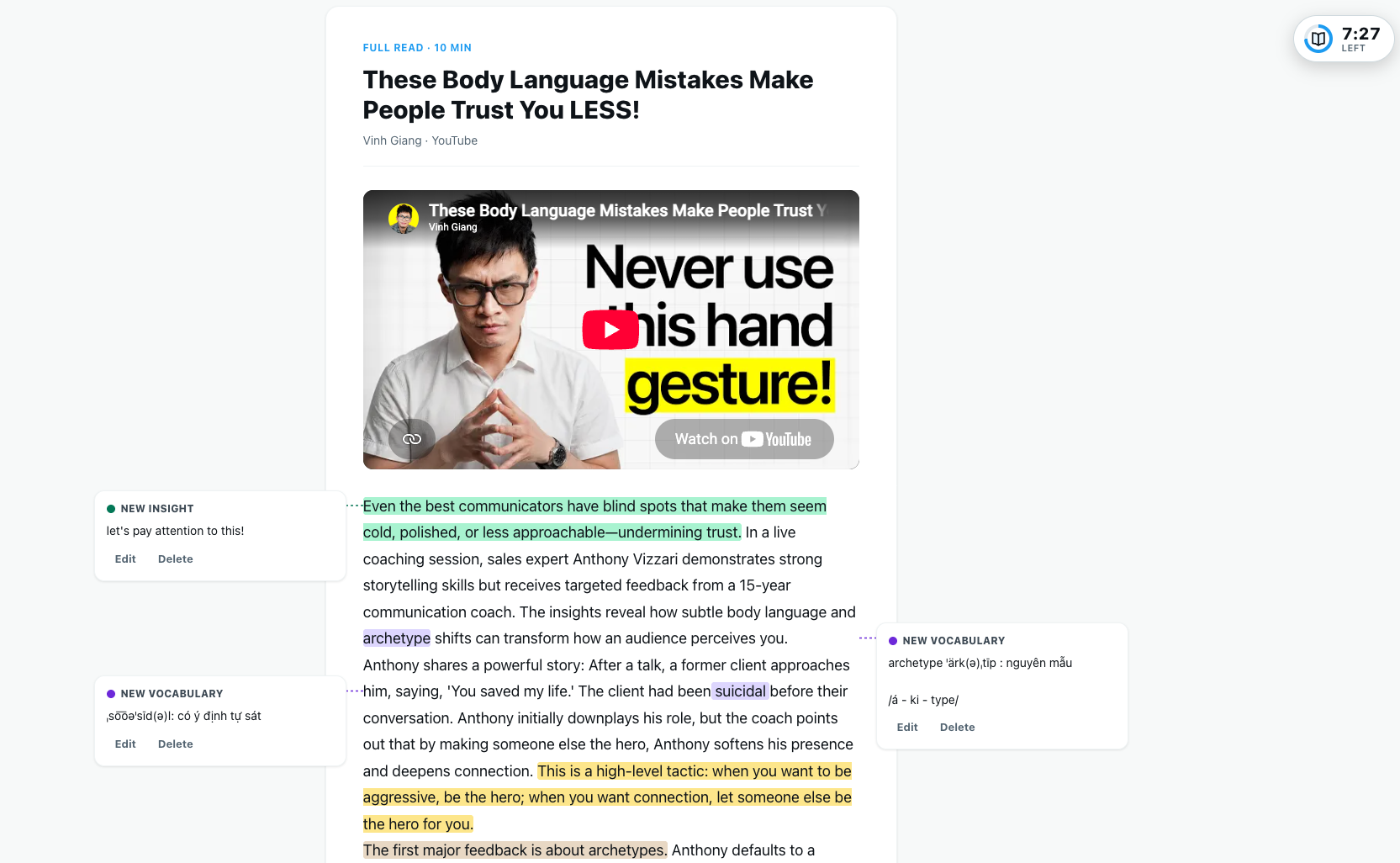
That consistency is what makes the marks pay off over time. You're not just saving quotes — you're building a personal, color-coded map of an idea that you can re-enter at any depth: the one-line version (main points only), the critical version (contradictions and concerns), or the whole thing.
Writing for future you
Every highlight is a small gift to a version of yourself who has forgotten most of this. Future you doesn't have time to re-read the source. Future you has thirty seconds and a vague memory that "there was something good in here." The color-coded card answers instantly.
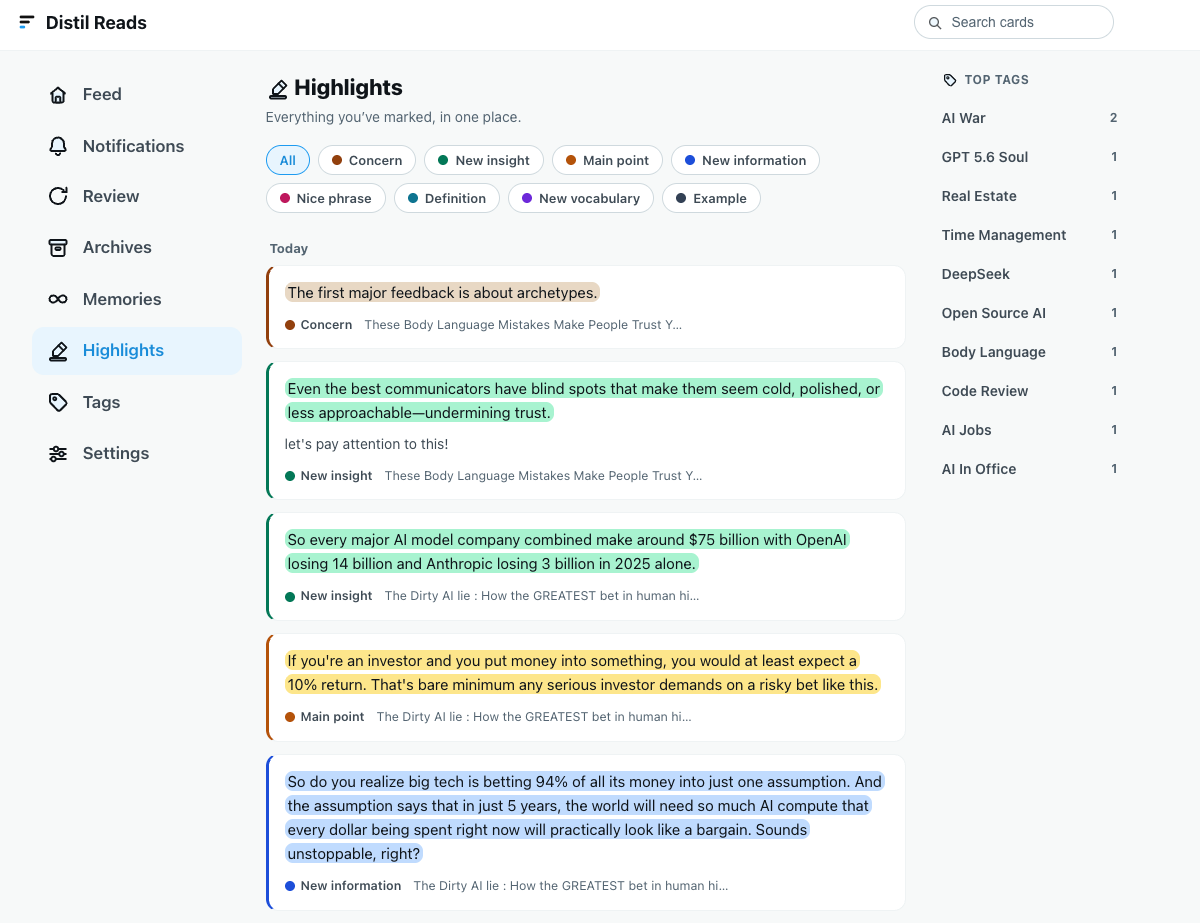
That's the real shift: from reading as consumption — in one end, out the other — to reading as construction, where each pass leaves behind a durable artifact you can return to. Same reading time. Radically different residue. Read it once, and actually find it again forever.