One feed can’t fit your whole life
July 11, 2026 · 6 min read
You are not the same reader on the morning train and at the dinner table. Your feed shouldn’t pretend you are.
At 7:40 on a Tuesday morning, wedged into a train with one hand on a pole, you are one kind of reader: distractible, interruptible, good for a short sharp idea and nothing heavier. At 9:15 that night, tea going cold, brain finally quiet, you are a completely different one: able to sit with a dense argument, willing to follow a footnote, actually capable of learning something.
Every feed you use insists these two people are the same person. One stream, one order, whatever's "top" served up identically regardless of whether you have four distracted minutes or forty focused ones. It's a strange assumption when you say it out loud — that the right thing to read is a property of the content alone, and has nothing to do with the moment you're in.
The tyranny of the single feed
A single feed forces an impossible compromise. Put your serious, concentration- heavy reading in it and most of the time you'll skip past — you're on the train, you're between meetings, you don't have the head for it. Fill it with light, skimmable stuff instead and your evenings, the one time you could actually go deep, get spent on fluff.
So the good material loses either way. The 45-minute lecture you genuinely want to absorb sits at the top of the feed during your commute, gets skipped because now is wrong, and slides down forever. The moment it was made for — Sunday morning, coffee, nowhere to be — arrives and it's buried under newer things.
Occasions: as many feeds as you have moments
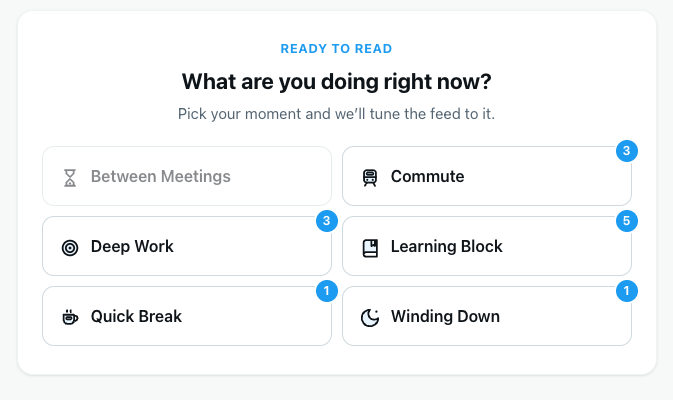
Distil Reads doesn't give you one feed. It gives you as many as you have situations, and calls them Occasions.
When you capture something, you tag it with the Occasion you'll actually want it in — Commute, Deep Work, Dinner, Winding Down, whatever fits your life. That 45-minute lecture goes to Deep Work. The three-minute explainer goes to Quick Break. The long-read essay goes to Sunday Morning. You're not sorting into folders for tidiness; you're routing each thing to the version of you that will be ready for it.
Then, when you open the app, you don't get a generic stream. You pick the moment you're in right now, and the feed assembles itself out of exactly the things you saved for this kind of moment. Commuting? Here's the light, punchy set you routed here. Settling in for deep work? Here's the heavy stuff, waiting where you left it, undisturbed by anything you'd never read on a train.
Why matching the moment matters more than it sounds
There's a real cognitive reason this works, beyond tidiness. Trying to read something that doesn't fit your current state isn't neutral — it's costly. Attempt a dense argument while distracted and you don't half-learn it; you mis-learn it, skim it, and register it as "done" so it never comes back. The single feed manufactures exactly this failure at scale: it constantly presents the wrong depth for the moment, and every mismatch is a thing you'll now never properly read.
Matching content to Occasion removes the mismatch. Serious reading only ever reaches you when you're equipped for it. Light reading fills the gaps that were going to be idle scrolling anyway. Nothing sits in the wrong place quietly decaying.
The quiet luxury of the right feed
The first time you open your Dinner Occasion and every card is genuinely dinner-shaped — nothing that demands more of you than you have to give — it feels like a small luxury. Not because the app did anything flashy, but because for once the feed met you where you were instead of where its metrics wanted you to be.
You are not one reader. You never were. Your feed should finally admit it.